
BOONSBORO, Md.—Visitors to the Boonsboro area find many interesting and historical sites to explore. There’s a trolley museum, a mountaintop tower dedicated to George Washington, an inn owned by famous author Nora Roberts, and the beautifully preserved Antietam National Battlefield. Now, travelers will also discover anew museum dedicated to the nation’s first federally funded highway.
“The National Road Museum is Maryland’s only museum dedicated specifically to the history and importance of this significant roadway,” says Reuben L. Moss, executive director of the new museum and the Boonsboro Trolley Station Museum next
door. “The highway’s eastern extension in our area was one of the oldest westward wagon roads in the region. It was also the first road to use the macadam stone paving process.”
The new museum is located near the halfway point between Baltimore and Cumberland— the latter being the city in which the National Road began its westward push over the Appalachian Mountains. Six miles west of Cumberland, the turnpike’s seven-sided 1835- era LaVale Toll Gate House still stands.
The new museum honors that tollhouse—and additional National Road landmarks such as the 1850 wrought iron Wheeling Suspension Bridge—that became foundations of American identity. Displays recount how early drivers traveled the road with horse teams
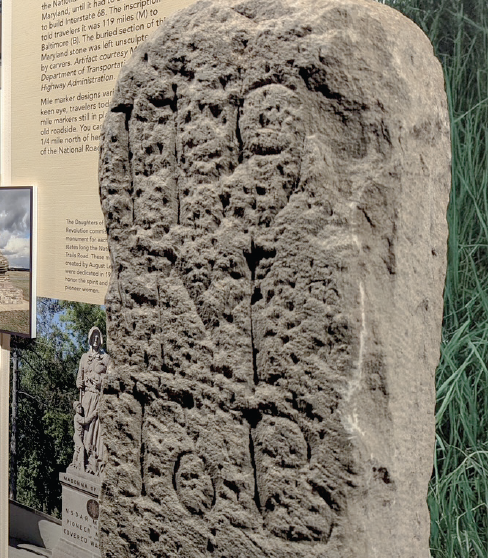
that were fitted with harness bells, and, later, in early Fords that struggled to climb uphill. Of particular interest is an original National Road stone mile marker. The limestone obelisk—pockmarked by decades of wind and rain—stood along the National Road near Flintstone, Maryland, until its removal was made necessary by the construction of modern Interstate 68. The inscription on its weathered face reads “119 M ToB”—which early travelers knew meant “119 miles to Baltimore.”
It’s all a reverential tribute to one of America’s most significant roads.

